Presented by haus of vovo in association with Mona Foma Supported by Arts Tasmania
Rona Stern and Alex Davern destabilise the symbols of the monumental. They’re reflecting the world at the moment, watching statues fall, leaving behind a plinth here and there as a reminder of How Not To Do Things.
In New Norfolk there are all these rocks that were once embedded with plaques that have long been removed. Just rectangular hollows which once celebrated something no longer relevant. It’s a kind of un-building, watching things dissolve into the powder of history. Davern and Stern do something like this. They define the properties of space with light, disrupt form with colour, and undo possibility by framing life within a hollow matrix. The things, the objects are still there but the sentimentality and the nostalgia have been erased. It allows space for the next thing.
Haus of Vovo is an independent gallery space curated by artist Tricky Walsh, created to support other artists with a focus on immersive or installation based practices.
Video: Tricky Walsh
Frogs in boiling water
The worst dream I’ve ever had felt like the world had been turned inside out; or upside down. Something akin to a rubber popper, ready to violently invert. It was clear that something was not right. There was this strange texture in the back of my throat while falling asleep; a peculiar sensation of grittiness and absorbency at the same time. The dream had something to do with the moon. The details were unclear, but the overwhelming dread was not. In a fever dream I sleepwalked that night, and without going into any more details, it did not turn out well.
Being included in Uneasy Architect has allowed me to continue my investigations into the intersection of light, architecture, and emotion. These artworks depict post-digital dimensions, blurring the lines between the familiar and the fantastical.
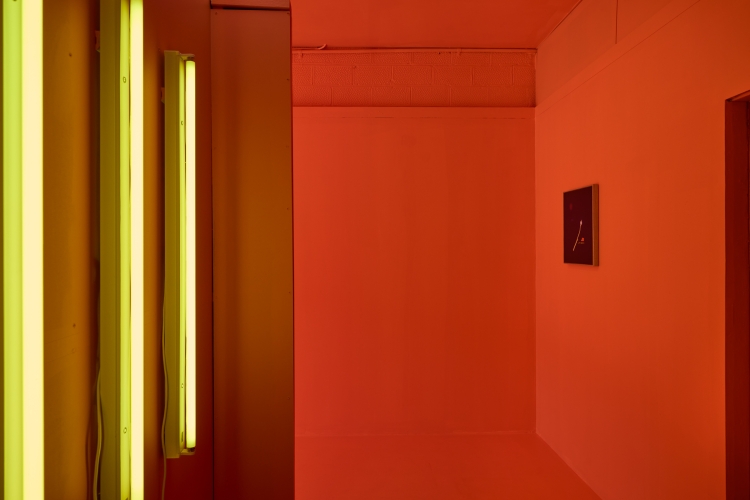
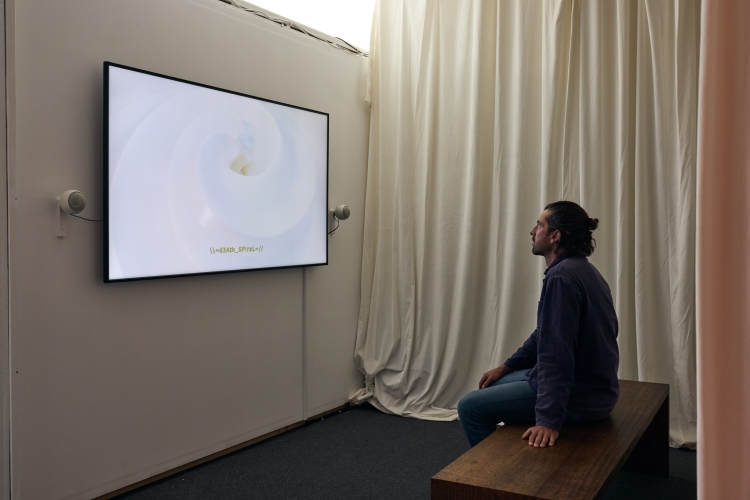
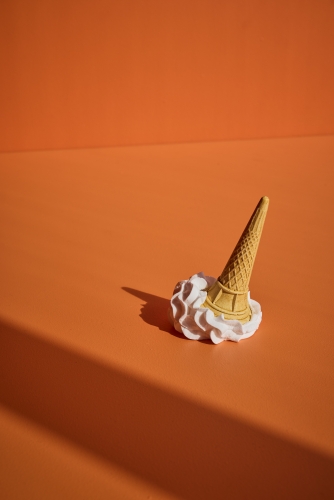
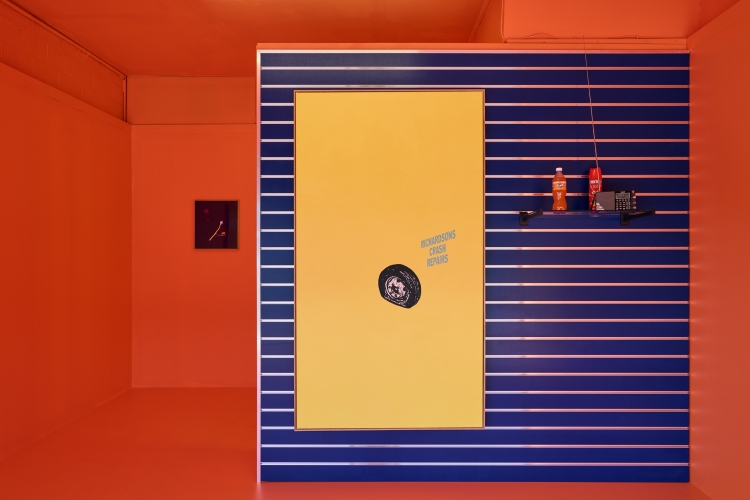
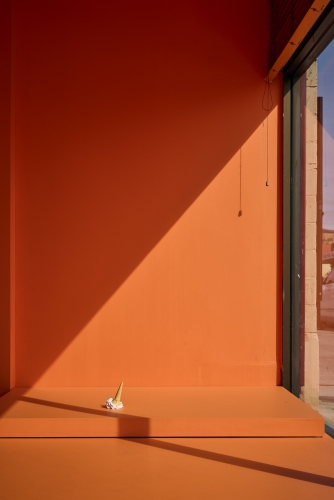
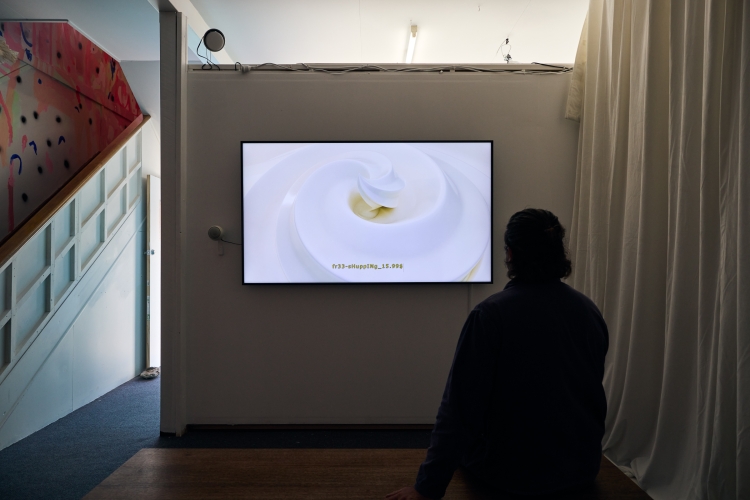
There are two halves to my contribution here at Haus of Vovo. I see these halves sort of like two distinct parts of the mind. Similar to opposing repetitive thoughts. You are greeted by an intense field of orange. A hot space. Works have been selected for their uneasy qualities. A flat tire, an upturned ice-cream, the increased usage of the word ‘heatwave’. Snippets of social media sound bites zip around the gallery. The secondary space has been designed to offer an embrace of sorts. Momentarily meditative and soothing, until it’s not. This ‘lighter’ space presents a rhythmic video installation featuring ‘mantras’ found through automatic writing and presented as fictional passwords over a hypnotic looped video of soft serve ice-cream. This video is driven by an endless distorted drone, only temporarily quelled by the ringing of a bell and the appearance of a password, only to rise again once the phrase has dissolved.
This collection of works is loosely inspired by the cycles and patterns of the universe; language and its ability to link us to the digital world, the analogue and the digital, the virtual and the real. Overall, I enjoy evoking a sense of ambiguity, challenging the audience to consider how consumerism, digital landscapes and internal mantras shape our perception of the world. -- Alex Davern.
A place where a burnout has Caché (Digital Folklore and the quest to end Polyphonic normatively)
"We need to stick thoughts inside the eyes of windows"
–Viktor Shklovsky (1964) from his memoir Zhili-byli (Once Upon A Time)
Paramount Godfather of the Berlin Dada movement Raoul Hausmann's1918 manifesto "New Materials in Painting" rejected the production of "masterpieces" in favour of a new formula, devoid of pictorial emphasis without the taint of "oil and vinegar." Painting's new materials, he declared from now should comprise the castoff and the ignoble. Materials so base that they would be even "rejected by the child." Conventional art supplies such as "colours on canvas, cardboard, artificial hair, wood, paper," might also be rehabilitated –Dada's "enormous refreshment." Hausmann called it.
In a mystical and exuberant universe, one cannot expect artistic perfection.
And nor should we because it's fascist.
A century later the cultural world is still comprehending the aesthetic position of Dada in all its offerings of lore, ambivalence, paradox, and effrontery. Despite this, many of Alex Davern's works remind me of Hausmann's Dadaist manifesto and lead me to wonder if some of them are in response to his provocations. I didn't ask him directly. This connection may not be a conscious one. I'm not entirely interested if it is a "yes" or "no". As a medium, I prefer ambivalence and enjoy scanning artworks for traces and omens. The most obvious clue to this potential tacit connection is CR3MƐ (2022-23), loops of soft serve data s0up spill out of the single-channel video as if a dropped or "rejected by the child" and manifests in the sculpture Untitled (ice-cream) (2022) by Kerry Samantha Boyes.
The central questions being asked by Dadaists –parallel almost uncannily those we face today in the twenty-first century: in the context of massive upheaval, displacement of populations, far-reaching technological change, the establishment of new forms of government and new kinds of commerce, and expanded media culture –What does it mean to be an artist? (A widespread reinvention of the role, ratios, and functions of art may goose-step with these era's shifts in industry, technology, and labour and amid the profound impact of momentous events: the black war, WWI, Russian Revolution, and civil war, the collapse of Empire, the rise of fascism…)
Conducting this close reading of Davern's works in Uneasy Architect is a bizarre and cryptic experience. As it can guide us through this open-ended question. Demonstrating the value of artists who actively engage in the social context of their work, by considering and reconsidering their own position. For instance, in the title No results found for "smooth apocalyptic hip hop" (2020-23), Davern embeds an implicity challenge–How can one make a Google search out of a painting? Playing a sort of trickster, he responds to the question in two other artworks in the show Not in this work per se. What does it mean? (2023) the faint typographic words WHITE VINEGAR is more than three times the scale of the emoji riffing rhapsody of the title. Almost in the style of a broadside, the painted text is presented in the manner of a dropdown menu, at first glance appears as if letterpressed onto a canvas. I <3U so much –is in yet another typeface gesturing to the handwritten graffiti you may find marked into a high school desk or inscribed on the toilet wall of a punk bar. A type of milky way is the faintest most ornamental motif sprayed around the backstage of the canvas –a backdrop in which the main action takes place–invoking an anachronistic quality of a painting. This is juxtaposed with a different architectural orientation totem in the upper left quadrant. The skill of the graphic designer in pictorialsing data and relationships, creating a didactic display punctuated public address. deploying the language of Reddit-style questions into a painting of agitational theatre.
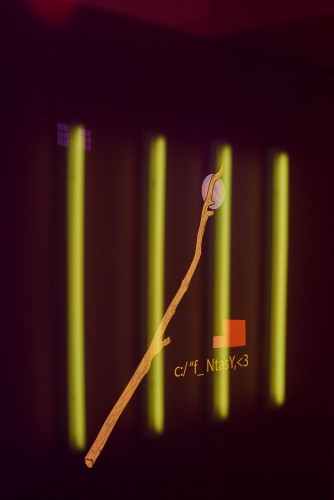
A luminous combination of blues and reds forged together create striations of indigo in Water underground (two moons) (2020-23). The motif as a royal one is long out of fashion –indigo was once the kind of colour that only a few were ordained to wear a few centuries ago. This work incorporates this cultural history through the decorative heraldry of the moon, as it is seen during a bush fire, a disembodied Apple Mac computer ON/OFF button caught in a twig, bestowing faux rank and honour to otherwise castoff elements: A building window lights glow and fade into the abyss of the canvas, an orange and pink remnant (I imagine it's a discarded cinema ticket). All the use of which also links Davern's practice to Dada. Positioned in a dark nowhere these figures are often backlit by a luminous hue that echoes position and outline. The geometries of abstraction provide a sense of animation, rhythm, and syncopation reminiscent of a film strip. It might be seen to emblematic the title subject: the swatches and digital detritus together form a new kind of aesthetic. But where Davern obtained the twig is still a mystery.
In the visual emblems of Davern's neomaterial works the window must be considered in the context of his work as his signature, or at least they are a reoccurring motif, not unlike a faery godmother, or spirit guide that returns to shine a light.
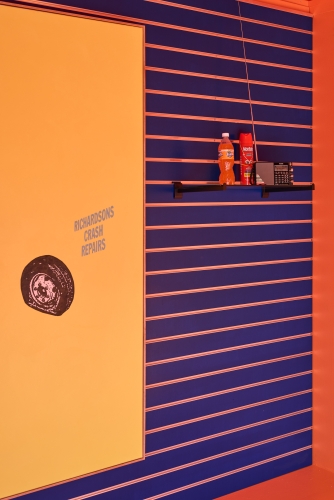
Bringing to life, the history and currency of an artwork that is contingent on the specifics of space, colour, and energetic form dominate in the work TIRE (2023). Davern locates the work within the wider environment where haus of vovo acknowledges the local surroundings. The large bold work is placed in the window in conversation with Richardson Crash Repairs.
While he could plausibly have used a cutout Davern insists on painting a black-and-white graphic novel style tire. This persistent figurative formalism technique sheds a mysterious and three-dimensional quality as if the subject is emerging from the void. Nestled in and creeping through the canvas overtaking the painted printed matter, depicting tools of industrial production and reproduction that ultimately superseded the hand and the handmade. The images themselves are mechanically prodded –whether via pronging technologies or in the computer terminal blackbox, juxtaposed with painted stencilled letters, there is little evidence of the hand's labour.
Through strategies of putting language and image in the service of the wider community to create charged meanings, in conversation with the immediate surroundings. Aligning himself with industry, situated locally, the use of vibrant colour and lively typography exemplify Davern's remarkable efforts to find a constructive and public role for the artist (the musician and the poet).
Here the burnout has caché.
Proposing an equivalence between the dynamiting promised by the car engine and the dynamism of painted shapes unravel and float a cutout stencil of a wheel. The canvas becomes not a print to hold but a veritable environment to enter. In Davern's almost bird's-eye rendering, we cannot know if there are exterior walls, or if the work is a prelude or post-script or a billboard of what is hidden inside the absent machine.
This show also features sound by Shawn Arnold. Hearing the cut-up D00M_scr0LL3N (2022) I am almost transported to a time in my 20s in a dodgy warehouse in Sydney listening to breakcore. One of the most vital subcultural currents coming out of Australia was breakcore - a style and microgenre of electronic cabaret music that emerged from jungle, hardcore, and drum and bass in the mid-to-late 1990s. Characterised by complex and intricate breakbeats and a wide palette of sampled source material. The worldwide breakcore cult emerged from Bloody Fist records, Newcastle Australia. Practices like these that misfit established disciplines could be aligned with the self-acclaimed "genius dilettantes" of EINSTÜRZENDE NEUBAUTEN in the 80s. Or, in the early days of the Internet, that once consisted of numerous collectives, each with its idiosyncratic activities, aesthetics in-jokes, and rules.
Like D00M_scr0LL3N, Water underground (two moons) (2020-23) and CR3MƐ (2022-23) have contents that gesture to the elite language of computer subculture leet speak | 1337 sp33k | l33tspeek. Calculating machines and their languages play an increasingly dominant role in influencing our desires and fears, concerns, and prejudices.
Here lies the rub, Davern returns the digital conventional modalities of the canvas. Refusing it. Arguably this style of engagement is entirely distinct to those artists who operate in a contemporary art context and have an in-depth understanding of the technical codes and programming languages required to construct bespoke digital experiences.
The pseudo l33tspeek in Davern's work fetishes and emblematic the content of computer subculture which begs the following questions:
*Does what Davern embeds in the gap speak to his subject?
*Who has the right to speak about digital folklore, or to repeat, or riff upon it, when authenticity is just as opaque and fleeting?
The mediums of movements like Dada and Breakcore were alive, quick, and dirty and do not rest easy on safe ground, they are reckless and risky. Not just in a metaphorical, wannabe sense, where everyone pretends to love experimentation and interdisciplinary, but once this type of artist is truly unorthodox, or tries to sell their work, get a job, or receive project funding, in most cases it is a far-flung reality. Unseating and reinventing the traditional artist, through the replacement of handicraft with production, through creation that is mechanical and industrial, reproducible and made from reproduction and directed to a mass audience does not go without conflict. Indeed, the dystopias and the utopias that many of these rebellious artistic movements promised by such courageous artists often came to brutal ends, a failure that must be acknowledged too.
Another way to consider these provocations - is to consider how Raoul Hausmann riffed and repurposed his 1918 manifesto throughout his oeuvre –it was written, delivered, retitled, printed, overprinted, photomontaged, collaged, refashioned and exhibited –one result was Synthetic Cinema of Painting (1918-19). This artwork tells us something about the status of the word in a moment of change (has this always been such a familiar experience?) when words cannot be taken for granted, as they are always being redefined, and are ever in flux. Grasping for a vocabulary many Australian local art practitioners read the aesthetics of digital folklore in work like Davern's as merely pop culture "millennial's visual lexicon of pop culture imagery" (Rothery, 2019). But this narrow view reinforces simplistic binaries of analogue and digital. It possesses a distinct lack of nuance about the dynamic ecology of aesthetic history, practice, and production.
Alternatively, the expression 'neomateriality' coined by Christiane Paul (2015) is suggested as a critical framework that reflects upon the dynamic and on the ever-changing media that we can deeply as expressive tools "The concept of neomateriality strives to describe an objecthood that incorporates networked digital technologies, and embeds, processes, and reflects back the data of humans and the environment, or reveals its own coded materiality and the way in which digital processes see our world." The realm where contemporary art and the digital assemble is in comprehension of the embodied encounter and expanded spatial-temporal parameters (often discussed as 'virtual' or immaterial, although this is too often in a naïve manner).
Dear Reader,
If this is all too theoretical for you. here is the eshay version of the paragraphs above:
I have resisted till now the urge to bang on about the celebration of digital materiality that this show clearly demonstrates. A parochial example is when a 'friend' says "I don't use Facebook anymore" perhaps because they suffer social media anxiety and need a moral high ground, but then you can observe their digital footprint and get confused as the actions don't meet their words. But they routinely d00m scroll Instagram (instead?) for serotonin hits. We arrive at the sad conclusion of WhatEVA. As they do the same thing, and both are owned by Meta the very same corporate media company.
Digital detox is a neoliberal cloak of privilege.
The normative polyphony of the virtual and physical entanglement of forces from elsewhere is something many of us experience. It is not always pleasant. For when a painter, photoshops a collage of you and them for a shared art exhibition poster, but in retrospect, they think the image is inappropriate (but they don't inform you about it). Then with all good intentions, your mother reposts it as a memory on Facebook a decade later. You receive a threat from, the painter to stop sharing the digital image, that they, themselves, in fact, designed, distributed, and shared. But you have no idea how many or who has copies of the digital object and when it may surface again. But somehow, it's on you. And you know it because as of now you are ignored (at exhibition openings and similar contexts). Thus, the process of constructing this digital object presents its own challenge to traditional artistic creation. Normative discourse and parables of the virtual, at their best, lack humbleness, and doubt, and have no respect for the vast realms and cosmology of elders' past. Yet, you can count on these type people to posture, and virtue signal whenever given the chance. It can end up bad. parochial, and boring.
As we have gleaned from these few examples of the atrocities around the real-world consequences of how there is practically no consideration or critical understanding of the relationship around aesthetic experience between art and technology, via once-unimaginable avenues of distribution. We certainly need more constructive critique and reflection about digital aesthetics and the neomaterial experience to be sure. This essay is not the place to fully unpack this - but it may do well to flag these more basic points about how the digital is a cultural apparatus from where the action of the artwork is generated is something to deeply consider.
And we may now understand a little bit more about how Dada artists emerged in a period of dizzying political, social, and economic turmoil and transformation, to redefine their roles as public actors in the context of advances in image making and reproduction and mass media –conditions that have much in common with those of artists like Alex Davern working in the twenty-first century.
Then as now, many artists are driven by an imperative to invent new forms in response to untenable societal circumstances –from war to revolution, displacement to economic collapse. Turning away from traditional forms invents new visual languages, engaging in novel ways with expanded audiences and establishing new infrastructures for the presentation and dissemination of artwork. Working as archivists, brand managers, publishers, editors, and curators, Dadaist's endeavours and aspirations are paralleled in the work of many artists today, who have at their disposal new digital tools and immeasurable expansive networks, and who are asking the same urgent questions: what are the mediums and strategies available now that best allow us to speak to this moment?
These are some thoughts how Alex Daven's explorations consider our contemporary experience of communications, architecture, and everyday life, through new creative means and efforts capture the attention of an increasingly mobile and distracted mass audience through scale, forceful graphics, and dyadic integration of text and image. Prompting us to ask: What does it mean to be an artist?
Nancy Mauro-Flude. February 2023
Notes:
Raoul Hausmann's 1918 manifesto "New Materials in Painting" is trans, in Lippard ed., Dadas on Art. pp. 59-61. And a typed manuscript dated April 1918 can be found at Berlinische Gaerie (BG-RHA 1202).


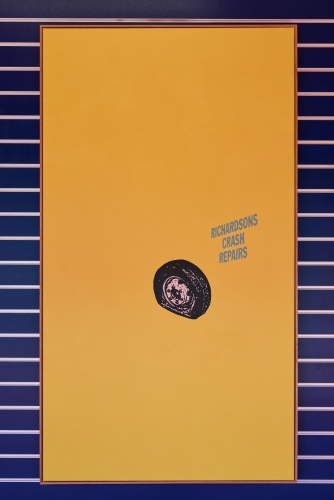 'TIRE'
 'Water Underground (Two Moons)'
 'No results found for "smooth apocalyptic hip hop"'
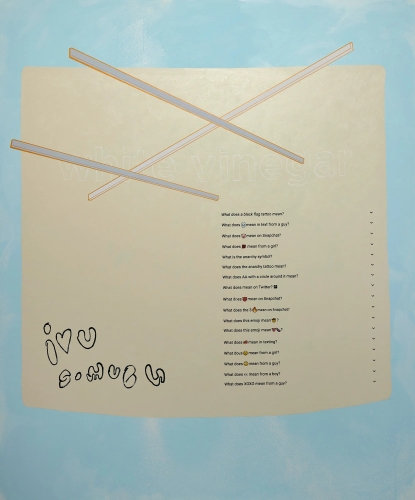 'What does it mean?'
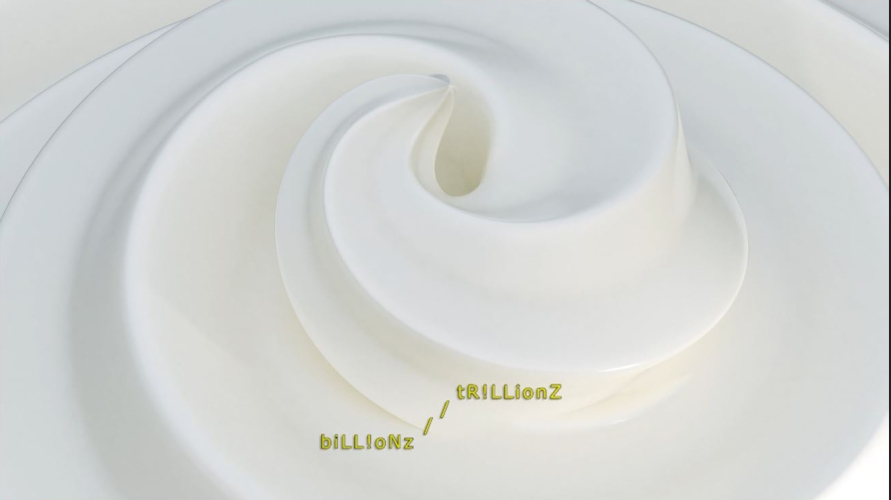 'CR3MƐ'
 'Kerry Samantha Boyes : Untitled (Ice-cream)'
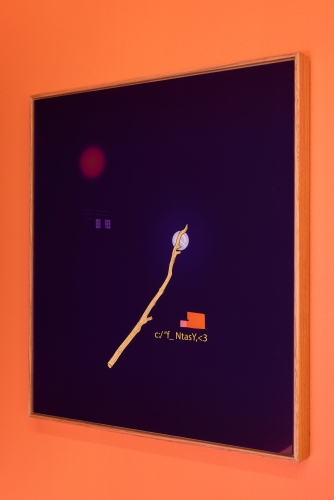 'Installation view'